
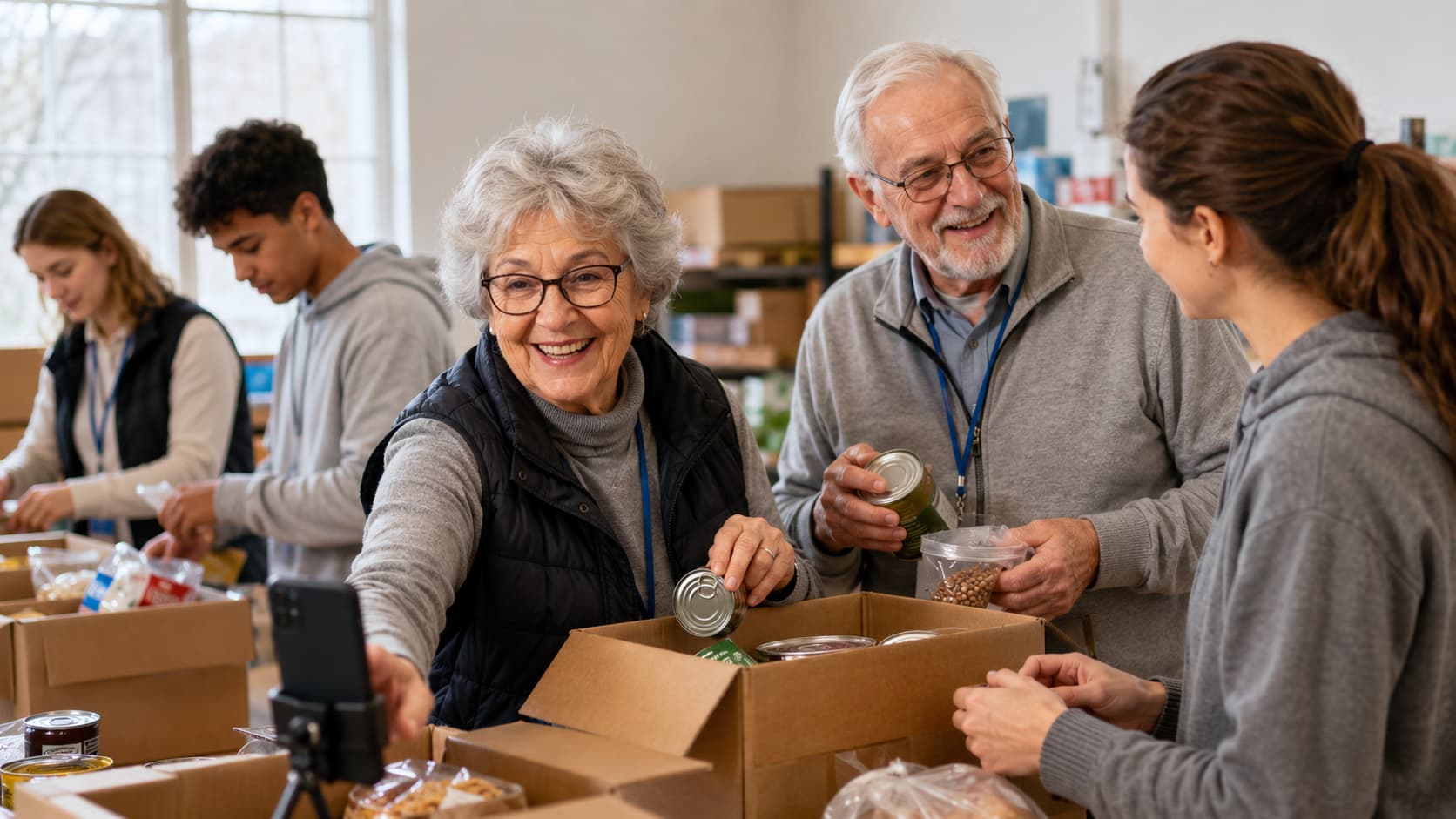
There is a quiet assumption baked into most images of volunteering: that it is a young person’s game, the territory of energetic students and twenty-somethings building a resume. The reality on the ground tells a very different story. Increasingly, the backbone of community service is gray-haired, and the most reliable, most experienced, and in some surprising cases most visible volunteers are the very people our culture tends to write off as past their prime. Older adults are not just participating in volunteering. They are reshaping what it looks like.
The numbers behind this are striking. Across two decades in which overall volunteering in the United States steadily declined, the contribution of people over sixty-five proved remarkably resilient. While the total hours served by everyone under sixty-five fell by more than half over that period, the hours given by the sixty-five-plus group dropped only slightly. The result is a dramatic shift in who actually does the work: the share of all volunteer hours contributed by older adults climbed from under a fifth to well over a quarter. And this happened despite the fact that more older people than ever are still in the workforce, and despite a pandemic that posed the greatest health risk precisely to that age group. When you tally the economic value, with a single volunteer hour now estimated at more than thirty-six dollars, the contribution of older volunteers runs into the tens of billions annually. They are not a charming footnote to the volunteer economy; they are a load-bearing wall.
Why are older adults such powerful volunteers? Part of it is practical. Many have retired or scaled back work, freeing up the one resource younger people most lack: time. But the deeper answer is about what they bring beyond hours. A lifetime of work delivers a stockpile of skills, accountants who can run a charity’s books, retired teachers who can tutor, former managers who can organize a chaotic relief effort, nurses who can staff a clinic. Experience that the market no longer pays for finds a second life in the nonprofit world, where it is desperately needed and freely given. Older volunteers also tend to be more dependable, showing up consistently in a sector that constantly battles no-shows and churn. For an organization, a reliable seventy-year-old is worth several enthusiastic but flaky recruits.
The benefits flow powerfully in the other direction too, and this is where the story becomes genuinely important rather than merely heartwarming. A substantial body of research links volunteering in later life to better health and longer life. Older adults who volunteer show lower rates of depression and loneliness, fewer limitations on physical functioning, and, in long-term studies, a measurably lower risk of death. The mechanism is not mysterious: volunteering provides purpose, structure, and social connection, the exact things that erode in retirement and whose loss drives so much of the decline associated with aging. In an era when loneliness among older people is treated as a public health crisis, volunteering functions as a kind of preventive medicine that also happens to help others. It is a rare win-win, good for the giver and the community at once, which is why international bodies increasingly frame older-adult volunteering as central to the whole project of healthy aging.
Then there is the most modern twist of all: the rise of the granfluencer. As social media has matured, a cohort of older people has stepped confidently in front of the camera, building large followings by being exactly who they are. These grandmother and grandfather influencers, the granfluencers, are quietly dismantling stereotypes about age and technology, and some are channeling their reach toward good. A charismatic older person sharing their volunteering, their causes, and their daily acts of service reaches audiences that a traditional charity appeal never could. They make giving back look not dutiful but joyful, not the preserve of the young but a lifelong habit that gets richer with age. In doing so they recruit across generations, inspiring both their peers and the grandchildren-aged viewers who follow them. The granfluencer turns the old script on its head: instead of younger people teaching elders how to use the internet, elders are using the internet to teach everyone how to live generously.
This shift is also changing how smart organizations operate. The trend across the sector is toward shorter, more flexible, more modular roles, and that flexibility suits older volunteers especially well, allowing people to contribute around health, energy, and family commitments rather than committing to rigid all-day shifts. Forward-thinking nonprofits are designing roles that draw on wisdom rather than just stamina, pairing the physical energy of younger volunteers with the judgment and skills of older ones. Some of the most effective programs are explicitly intergenerational, putting a retired engineer and a college student on the same project so each learns from the other. The age diversity becomes a strength rather than an awkward gap to manage.
None of this means older volunteering is without challenges. Health limitations are real, transport can be a barrier, and organizations sometimes underestimate what older people are willing and able to do, offering them only token tasks. The opportunity for any community group is to meet older volunteers where they are: to value their experience, accommodate their needs, and resist the lazy assumption that meaningful contribution belongs to the young.
The bigger picture is impossible to ignore. The population is aging fast, with the number of older adults set to grow by tens of millions in the coming decades. That demographic wave could be framed as a burden, a swelling population of dependents. The volunteers reshaping their communities suggest a far better framing. Here is an enormous, growing pool of skilled, motivated, time-rich people who, given the chance, will pour their experience back into society and grow healthier and happier for doing it. The grandmother packing food parcels and the granfluencer rallying her followers are telling us the same thing. Giving back is not something you age out of. For many, it is something you finally have the time, the wisdom, and the freedom to do properly.